Kazakhstan Releases Second Tiger As Ambitious Reintroduction Project Takes Shape
A male tiger named Amur has joined a female called Umit in a Kazakh nature reserve, marking the return of the predators to the country nearly 80 years after they vanished.
By Haruka Ivanov ·
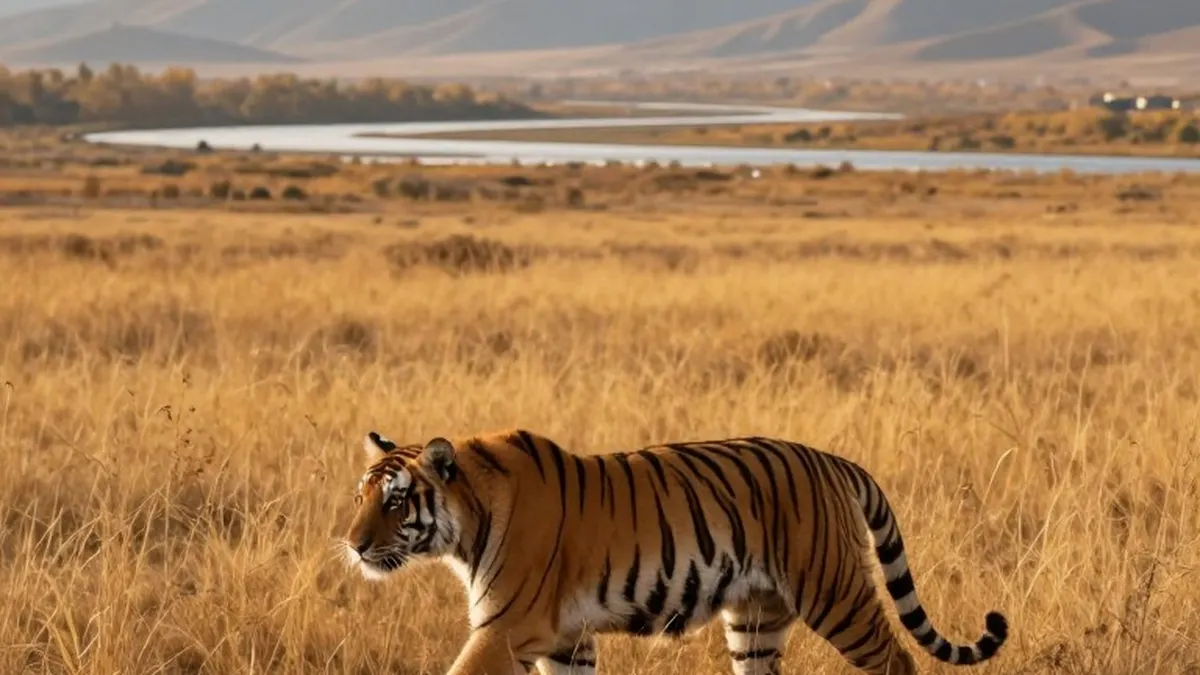
Tigers are once again roaming the wilderness of Kazakhstan, almost 80 years after the last of the predators was sighted in the country. On November 2, the Ecology and Natural Resources Ministry announced the release of a male tiger named Amur into a nature reserve created to host the big cats.
Amur now shares the Ile-Balkhash State Nature Reserve, located about 300 kilometers northwest of Almaty, with a female tiger from Russia named Umit, who was set loose in the same reserve on July 31. Within 10 days of her release, the female had killed and eaten a boar and a wolf, and she has reportedly adapted successfully to life in the Kazakh wild.
Not everyone nearby is welcoming the project. Valery Bilyachenko, who runs a recreational fishing base close to the release site, told RFE/RL that local residents are largely opposed to the reintroduction. "The main livelihood in the local villages is livestock farming," he said. "There are pastures and cattle, and naturally, local people are worried that the tigers will kill their animals." Some villages lie just tens of kilometers from where the two tigers were released.
Authorities say precautions are in place. According to Bilyachenko, the tigers wear satellite tracking collars so their movements can be monitored, and special teams will be dispatched to drive the animals away if they approach villages. Kazakhstan has pledged to maintain roaming anti-conflict teams to prevent clashes between tigers and people or livestock, and automated text messages will reportedly warn residents whenever a tiger comes within 5 kilometers of a village or farm.
"Our main goal is not simply to return these predators to their historic range but to establish a stable population capable of living and breeding independently in the wild," Alibek Kuantyrov of the Ecology and Natural Resources Ministry said after Amur's release. Officials hope the two tigers will eventually find each other and produce what they call a tiger wedding, though experts caution that the chances of the pair mating are small.
Two more young tigers are scheduled to be released into the reserve in 2027, and the long-term aim is a population of around 50 big cats in the Kazakh wilderness. That could open the door to tiger-spotting tourism, but Bilyachenko noted it might also make people less willing to freely enjoy the outdoors in the area, even if he expects little impact on his fishing lodge business in the near term.
The Ile-Balkhash reserve was established in 2018 and has been prepared specifically for tigers, with more than 200 deer and over 100 kulans, a donkey-like animal native to Central Asia, introduced to build up the prey base. The $30 million project is a joint effort between Kazakhstan and Russia, which supplies the animals, and has been funded by the World Wildlife Fund, the UNDP, and Kazakhstan.
Kazakhstan once held a significant tiger population, but hunting and habitat destruction reduced their numbers to an estimated 10 animals by the mid-1930s. By 1948, the big cats are believed to have disappeared entirely from the territory of today's Kazakhstan.
"This project sends a signal to the world. No country has ever restored a historically extinct species of large mammal, especially a predator," said Sergey Aramilev, director-general of Russia's Amur Tiger Center. If the initiative succeeds, he added, the reintroduction "will show other countries that it is possible."
Source: RFE/RL