Gambia Magistrate Krubally Presides Over 1,000 Cases in Courts Built for Sighted Users
Ten years after becoming the country's first blind magistrate, Muhammed Krubally continues to rely on assistive technology and memory to handle a heavy caseload in a system where official accessibility data remains scarce.
By Kavya Lin ·
Magistrate Muhammed Krubally arrives early at the Banjul Magistrates’ Court each morning, where his clerk reviews the day’s files before proceedings begin. At 41, Krubally has presided over more than 1,000 civil and criminal cases since joining the bench in 2016. He is the first visually impaired person to hold the position in the Gambia, a distinction confirmed by the Gambia Organisation of the Visually Impaired.
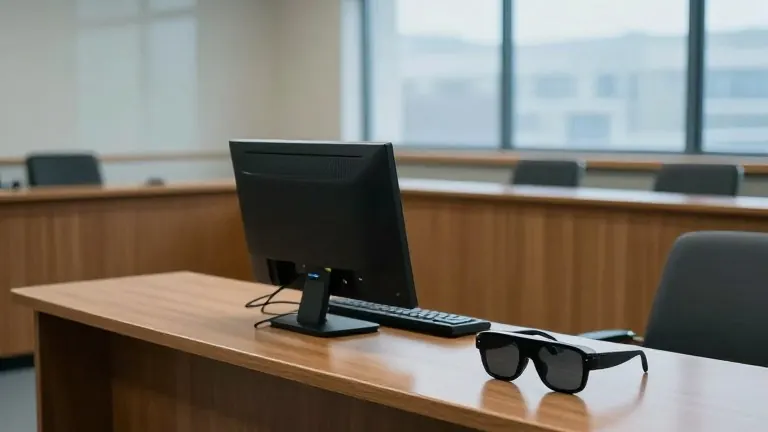
His daily workflow depends on a combination of auditory attention and digital tools. Krubally uses JAWS, a screen reader software, to access computer documents and judgments. He also wears AI-enabled smart glasses to perform tasks independently. In the courtroom, he tracks the rhythm of proceedings by listening to lawyers, witnesses, and the movement of papers, while his clerk provides immediate support when needed.
Krubally states that this technology makes his job easy, but he emphasizes that the role is his profession rather than an experiment. He entered the judiciary to make the system more inclusive, a goal shaped by his early education in the Central River Region. As the second of nine children, he faced limited resources and discouragement from peers and teachers, which he says strengthened his ambition to defend the rights of people with disabilities.
The Gambia passed the Persons with Disabilities Act in 2021, establishing principles of non-discrimination, accessibility, and equal opportunity. However, the National Human Rights Commission reports that barriers to education, employment, and services persist. The Ministry of Gender, Children and Social Welfare did not respond to inquiries regarding the implementation of these provisions or specific measures to improve accessibility.
Challenges are evident in the education sector, where the transition from specialized support to mainstream schooling remains difficult. Lamin Colley, head of the Gambia Organisation of the Visually Impaired Resource Centre for the Blind, noted that 49 pupils aged four to 14 currently attend the facility. Upon graduation, these students enter mainstream schools where special-needs teachers are meant to provide support across large clusters.
Colley indicated that limited learning materials and the size of these clusters strain available resources, leaving a single teacher unable to maintain regular contact with all students. He attributed this gap partly to insufficient government funding for disability issues in the national budget. Colley described the current situation as one where little has changed on the ground since the 2021 law was enacted.
Similar barriers exist in other public institutions. Ndey Yassin Secka-Sallah, the country's only visually impaired parliamentarian, stated that she previously relied on colleagues to understand parliamentary discussions. She expressed a desire for independence in her role. Musa Barrow, a lecturer in media law and ethics, faces similar assumptions from students regarding his teaching capabilities, though he uses digital tools to prepare notes and deliver lectures independently.
Data on the scale of disability in the country remains incomplete. The 2013 Population and Housing Census recorded 21,873 people with a disability, representing 1.2 percent of the population, but used narrow questions that may understate the true number. A new census conducted later, with preliminary results released in September 2024, did not include detailed updated disability data in its initial report.
The judiciary did not respond to questions about specific accommodations for Krubally or general accessibility measures for court users with disabilities. Krubally continues to mentor young people, including Modou Lamin Dampha, who cites the magistrate as an encouragement to pursue professional ambitions. Krubally said he sees possibility rather than obstacles when looking toward the future.
Source: Al Jazeera