
Israeli election results leave Netanyahu short of majority, boost Arab blocs
Palestinian parties are projected to hold 19 seats, forcing opposition leaders to consider new alliances to form a government.
By Kavya Lin ·
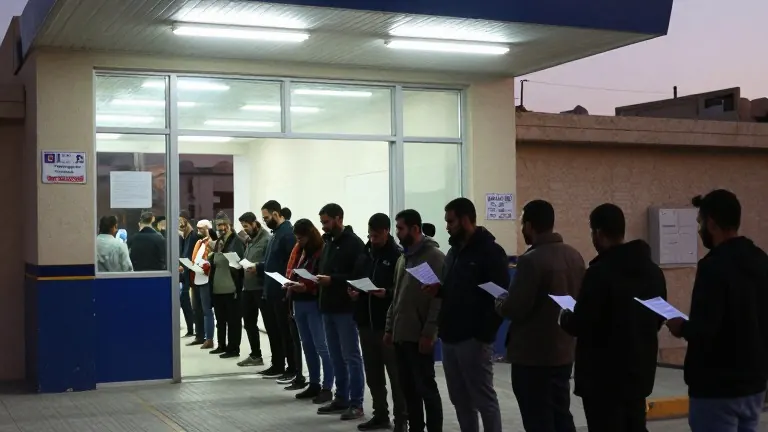
Benjamin Netanyahu’s coalition lost ground in Israel’s election but avoided total defeat, leaving the prime minister in a position to negotiate a new government.
The vote results show that Netanyahu’s bloc, which includes his Likud party and allies, fell between eight and 10 seats compared to the 2022 election. This drop left the coalition short of the 61 seats required to form a majority in the 120-seat Knesset. Despite this loss, Netanyahu argued that his campaign message resonated with Jewish voters who accepted his plan to continue ongoing wars and maintain a state of emergency. He told voters that the Hamas-led attack on October 7, 2023, was a failure of military leadership, not his own, and claimed his intervention made Israel safer. His strategy successfully forced his opponents in the change campaign into a minority, complicating their path to power.
Arab parties achieved their highest level of representation in the Knesset, with the Joint List and Mansour Abbas’s Raam party combined projected to win as many as 19 seats. This record for Arab participation signals a shift in the political balance, as these parties now hold the key to determining who forms the next government. The Joint List, a coalition of Palestinian parties, received roughly twice as many votes as Raam, indicating a preference among Israeli Palestinians for a united front that emphasizes their identity and the plight of Palestinians under occupation. In contrast, Raam has pursued a strategy of working with Jewish Zionist parties to secure material gains for the community, such as better education, development, and security, often by decoupling domestic issues from those in Gaza and the West Bank.
The election results have forced the Jewish secular liberal camp to reconsider its traditional rejection of alliances with Arab parties. Opposition leader Gadi Eisenkot and other centrists had hoped to win a majority by opposing the ultra-Orthodox community and aligning with the military. The high turnout among Palestinian voters, which analysts say was driven by a desire to block the far-right figures Itamar Ben Gvir and Bezalel Smotrich, demonstrated that the secular opposition cannot win without Arab support. If Netanyahu forms a unity government, it is unlikely to include Ben Gvir and Smotrich, which would validate the Palestinian bloc’s influence. Conversely, if the opposition forms a government, they must now negotiate with the Arab parties, a move that requires practical cooperation despite historical ideological differences.
Yousef Jabareen, chair of the Joint List, outlined four conditions for supporting a government to replace Netanyahu: combatting crime, expanding Palestinian communities, securing civil rights for Arabs, and establishing a clear process toward an independent Palestinian state. These demands place the issue of Palestinian identity and the occupation directly on the table for any future coalition talks. The Palestinian community in Israel, which makes up 20 percent of the population, has historically been excluded from government. With their new political weight, they are now positioned to influence the selection of the next prime minister. The challenge for both the secular centrists and Palestinian citizens is to find a middle ground that allows for cooperation without sacrificing the core demands of the Palestinian community.
Source: Middle East Eye