Oxford Street: 1.2 Miles Become Car-Free Zone
London's mayor declared the pedestrianisation a momentous day, but drivers and cyclists report new challenges on the streets.
By Kavya Lin ·
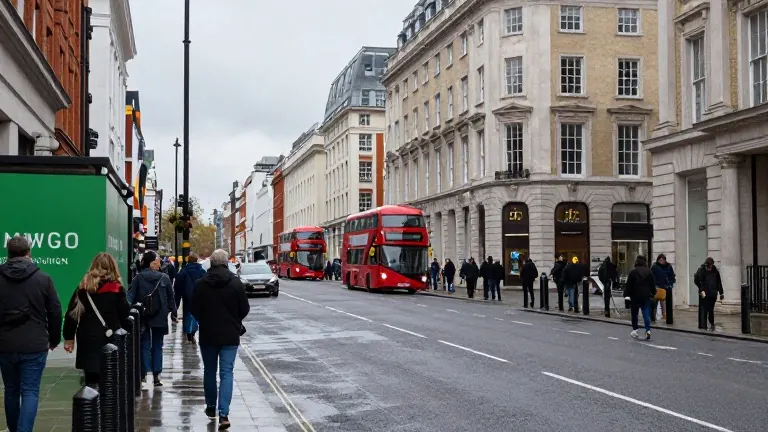
London’s most famous shopping street has lost its cars. As of Monday morning, roughly half of Oxford Street, a stretch of 1.2 miles, is closed to traffic. The change removes buses, bikes, taxis, and private vehicles from the area between Oxford Circus station and Marble Arch. This is the first phase of a larger project intended to reshape the street before the busy Christmas shopping period.
Sadiq Khan, the mayor of London, marked the opening at a speech in John Lewis. He called the day "momentous" and described the street as having been in decline for the last couple of decades. Khan stated that pedestrianising the area, combined with public transport links and more greenery, would lead to a better experience for everyone. He framed the move as a proof of concept, arguing that investing in people rather than traffic leads to better footfall and spending.
Shoppers who visited the street on Monday expressed enthusiasm for the extra space. Daniel Te, who moved to London from the US in July, stopped to sketch the scene. He said he used to avoid the street because it was too busy, but the new space made him more inclined to visit. Te compared the new layout to the scramble crossing at Oxford Circus, noting that seeing the whole street become like that intersection was exciting. He called the pedestrianisation a big achievement, though he acknowledged that rerouting buses might make some journeys more inconvenient.
Raquel Cox, a visitor from Ireland, said she came to the street after seeing news coverage. She described the change as a better experience for shoppers, despite acknowledging that surrounding streets might get busier. Abbas Shigival, who runs a souvenir kiosk at the start of the pedestrianised section, said the morning was a little busier than usual. He called the environment more pleasant because people could walk around without the pressure of traffic. He said it would take time to determine the full impact on his business.
Transport for London says the changes will not affect bus reliability. Claire Mann, the chief operating officer, stated there is still plenty of capacity for passengers. She noted that the Elizabeth Line and Bond Street provide alternative ways to arrive at the area. However, some residents and workers are less convinced. Ben McMullan, a taxi driver, said traffic on surrounding streets is definitely worse. He reported getting stuck in areas he previously avoided and mentioned dropping off customers who struggled with the lack of direct car access, including a mother with a pram and a woman with walking difficulties. McMullan fears the change will hurt his business as customers realize they cannot get to their destinations directly.
Cyclists are facing a new barrier. Jack, a cyclist on his way home from a construction job, was stopped by security guards multiple times while riding down the street. He said an alternative route would make his commute longer and that he intends to ride down the road regardless of the rules. He disagreed with the pedestrianisation on principle, noting that London already has many low traffic neighbourhoods that make it harder for people to use vehicles.
The current closure is temporary. The permanent transformation, a 150 million pound project, includes trees, seating, and level plazas for events. Work on that phase is scheduled to begin in spring 2027. Khan said London would closely monitor the changes to ensure they are working for everyone. The final permanent plans will depend on feedback from this first phase and ongoing testing.
The street remains open to pedestrians and those with specific access needs. Double-decker buses are now diverted into neighbouring roads. The area east of Oxford Circus remains busy with traffic, while the western section is marked by green welcome banners and temporary bollards. The shift in traffic patterns is already visible to commuters and shoppers alike, with some embracing the open space and others adapting to the new constraints on mobility.
Source: The Guardian