Israeli Election: Turnout Hits 17% in First Hours as Voters Weigh War's Aftermath
More than 7 million citizens are eligible to vote in a tight race between Prime Minister Benjamin Netanyahu and former military chief Gadi Eisenkot, with early figures showing record participation.
By Kavya Lin ·

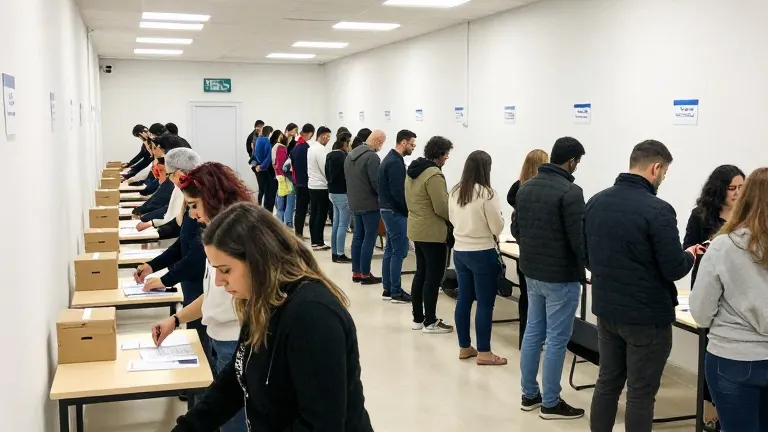
Israeli citizens voted on Tuesday in a national election that determines the country's leadership following three years of conflict and unresolved regional tensions.
The Central Elections Committee reported that nearly 17 percent of eligible voters cast ballots during the first three hours of voting. This represents the highest turnout for that specific time window since 1981. Over 7 million people were eligible to participate, and tens of thousands of residents living abroad traveled to Israel to vote.
Prime Minister Benjamin Netanyahu faces a fragmented field of opponents seeking to end his tenure as the country's longest-serving premier. Opinion polls indicate a close contest between Netanyahu and his primary rival, former military chief Gadi Eisenkot. The election is the first national vote since the Hamas attack on October 7, 2023, which initiated the war in Gaza and related conflicts in the region.
In Kiryat Shmona, a stronghold near the Lebanese border, one man tore down a poster of Eisenkot before polls opened. In Tel Aviv, families of victims and former hostages observed a moment of silence. Yona Adam, whose daughter Mapal Adam was killed on October 7, urged voters to remember those who died. Eisenkot visited communities attacked on that day early Tuesday and stated that a responsible government would begin its term there. Netanyahu had not appeared in public three hours after voting started.
Political dynamics remain complex due to Israel's parliamentary system, which rarely produces a single-party majority. Neither Netanyahu's religious and ultranationalist coalition nor the anti-Netanyahu bloc currently holds a clear path to a majority. This could trigger weeks of coalition negotiations. Israel's Arab-led parties, which are pushing for high participation, may serve as kingmakers. Mansour Abbas, head of the Ra’am party, said his vote would change the government and hoped for turnout above 70 percent in Arab communities.
Far-right National Security Minister Itamar Ben-Gvir warned that if Netanyahu and his allies do not win, the resulting government would be led by Mansour Abbas. Ben-Gvir has previously stated that some Palestinians in Gaza are not even people. Tensions with Iran also loom over the vote, with Netanyahu warning Tehran of a devastating blow if it attacks Israel. He appeared in a video standing beside a missile-defense battery to deliver this message.
The Yashar party, led by Eisenkot, filed an urgent complaint regarding nine incidents where ballot slips were missing, damaged, or turned over in voting booths. The party described the issues as a systematic and deliberate sabotage attempt. Dean Livne, the acting director-general of the elections committee, stated that reports of irregularities were lower than in previous elections.
Approximately 330,000 young Israelis, many of whom face compulsory military service, are voting for the first time. The election addresses questions regarding security, military conscription, and the role of religion in the state. Eisenkot, whose son and two nephews were killed in Gaza, is seen by supporters as a leader with strong security credentials. Parties backing him have pledged to improve Israel's international standing, conscript ultra-Orthodox men, and bolster judicial independence. Nisso Shitrit, a voter in Jaffa, described the vote as a decision on who serves and who evades service.
Israel's traditional allies have increased criticism of the country's conduct in Gaza and the occupied West Bank, where settler violence has intensified. Public support in the United States has declined, and European partners have imposed sanctions in recent months. The outcome will determine whether Israel continues under Netanyahu's leadership, who faces an ongoing corruption trial, or shifts toward a coalition focused on secular and liberal values.
Source: KNSD