US cancels G20 photo over Russia dispute
European diplomats threatened to leave the stage rather than stand beside Sergey Lavrov, forcing a last-minute change to the opening ceremony in Atlanta.
By Pavel Henderson ·
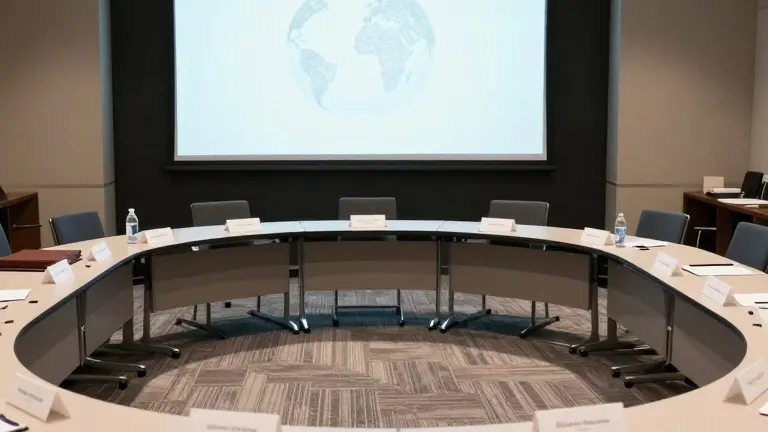
The Group of 20 meeting in Atlanta began with a visible fracture among the world's largest economies. On Friday, U.S. Secretary of State Marco Rubio scrapped the traditional opening group photo after several European foreign ministers objected to being pictured with Russian Foreign Minister Sergey Lavrov. The decision came as diplomats gathered to discuss global security and trade before a leaders' summit planned for December.
Two U.S. officials said Rubio determined the controversy would distract from the talks. The meeting proceeds as scheduled, with Rubio opening the session by describing the moment as one of choosing for the United States and the world. He noted that the group faces interconnected economic and geopolitical crises that threaten the foundations of the global economic order.
The photo dispute was not an isolated incident. Several G20 nations had already voiced concern about inviting Russia while it intensifies attacks on Ukraine. Polish Deputy Prime Minister and Foreign Minister Radosław Sikorski called the cancellation the right decision. He told media in Atlanta that he was not the only one who did not want to be photographed with Lavrov.
German Foreign Minister Johann Wadephul told the news agency dpa that there is no normality with Russia. He stated that participants must exchange controversies at the table but must not send falsely optimistic signals. Russian Foreign Ministry spokeswoman Maria Zakharova said visa issues for the delegation were resolved at the last minute, creating an impression that not everyone in Washington was happy about Lavrov's attendance.
South Africa, a founding G20 member, was not invited to the meeting. U.S. officials said they chose to include only formal members, a decision that excluded Ukraine, which had attended previous meetings. South African spokesperson Phindile Kunene said the country's nonparticipation is not voluntary. She noted that South Africa is ready to participate on an equal footing when Britain takes over the G20 presidency next year.
Analysts see the gathering as a test of U.S. ability to build cooperation. Ian Kelly, a former U.S. ambassador to Georgia, said it seems politically boneheaded to invite Lavrov given domestic pressure on President Donald Trump. He noted that many Republican lawmakers are critical of the administration's conciliatory approach to Russia. Elaine Dezenski of the Foundation for Defense of Democracies described the meeting as a test of whether the U.S. can build cooperation when consensus appears out of reach.
The agenda includes resolving differences on freedom of navigation in the Strait of Hormuz, the Red Sea, the Black Sea, and the South China Sea. The U.S. has said this is a top priority. However, the prospect of new U.S. military intervention in Iran hangs over the discussions. U.S. officials have told regional allies to prepare for potential strikes after the midterm elections, a development that has put G20 member Saudi Arabia on edge.
It is unclear if Russian President Vladimir Putin will accept Trump's invitation to the December summit in Miami. The current meeting aims to set the stage for that event, but the visible disagreements on the opening day suggest the path to a unified message remains difficult.
Source: The San Diego Union-Tribune